
From the Editor
Editor-in-chief of the journal «New psychological research» T. D. Martsinkovskaya, Moscow, 26 September 2026
Dear colleagues, the new academic year is upon us, and with it comes our third autumn issue.
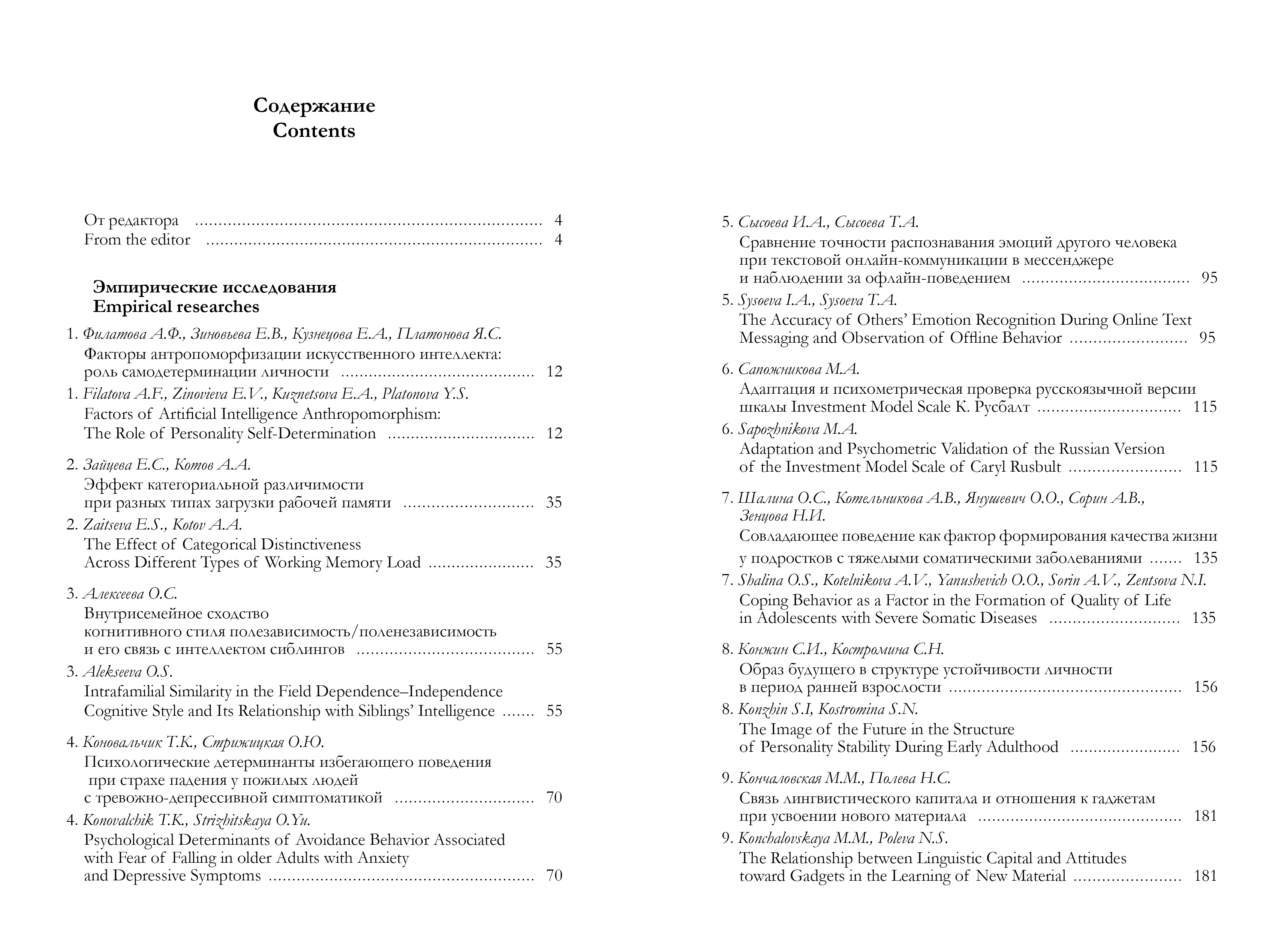
The issue opens with an article by A.F. Filatova, E.V. Zinovyeva, E.A. Kuznetsova, and Ya.S. Platonova, devoted to a highly relevant topic: “Factors of Artificial Intelligence Anthropomorphization: The Role of Personal Self-Determination”. The study examines the link between the process of AI anthropomorphization and individual autonomy and self-determination. The authors hypothesized that the degree of various types of self-determination in users outlines how they perceive AI (ranging from a mere tool to a “quasi-subject” of social interaction). The findings indicate that the level of AI anthropomorphization is positively correlated with various types of personal self-determination: persons, who are more autonomous and proactive are more active in mastering and “humanizing” AI systems.
In their paper “The Categorical Distinctiveness Effect Under Different Types of Working Memory Load”, E.S. Zaitseva and A.A. Kotov investigated the categorical distinctiveness effect under conditions of varying working memory loads—specifically, verbal and visual. The study tested the hypothesis that the categorical distinctiveness effect depends on verbal processes, a finding significant for understanding the interaction between semantic and working memory. The results demonstrated that the categorical distinctiveness effect is driven by the activation of verbal processes involved in information control within working memory.
O.S. Alekseeva’s article, “Intrafamilial Similarity in the Field-Dependence/Field-Independence Cognitive Style and Its Relationship with Sibling Intelligence”, explores the nature of the relationships between field-dependence/field-independence and intelligence metrics in siblings and their mothers. The study revealed intrapair similarities in cognitive style measures between older and younger siblings. These data confirm the familial resemblance regarding field dependence/independence and the relationship of this construct to the intellectual indicators of siblings and their mothers, although dependence/independence cannot be fully reduced to the level of psychometric intelligence.
The article by T.K. Konovalchik and O.Yu. Strizhitskaya, “Psychological Determinants of Avoidance Behavior Associated with Fear of Falling in Older Adults with Anxiety-Depressive Symptoms”, examines the relevant and widespread phenomenon of the fear of falling among the elderly. The study demonstrated that depressive symptoms are associated with high levels of fear of falling and avoidance behavior. The findings led to the conclusion that behavior associated with the fear of falling is determined by a combination of emotional, cognitive, behavioral, and somatic factors; this underscores the need for a differentiated approach to the psychological assessment of older adults with a fear of falling and the selection of appropriate interventions.
The article by I.A. Sysoeva and T.A. Sysoeva, “Comparison of the Accuracy of Recognizing Another Person's Emotions in Text-Based Online Messenger Communication versus Observing Offline Behavior”, is devoted to the important subject of emotion recognition across different modes of communication. The results indicate no statistically significant differences in accuracy or sensitivity regarding emotion recognition between the two situations studied. Emotion recognition accuracy does not diminish due to the absence of non-verbal cues typical of offline observation; it appears that cues specific to text-based online communication are sufficient for assessing a conversation partner's emotions.
M.A. Sapozhnikova’s paper, “Adaptation and Psychometric Validation of the Russian-Language Version of C. Rusbult’s Investment Model Scale”, describes the adaptation and psychometric validation of the “Investment Model Scale” (IMS) using a Russian sample. Confirmatory factor analysis confirmed the questionnaire's four-factor structure (satisfaction, investments, quality of alternatives, and commitment). The best fit indices were observed in a model that excluded specific aspect-related items and relied instead on global indicators (CFI = 0.913; TLI = 0.901; SRMR = 0.068). The adapted Russian version of the Investment Model Scale is a reliable and valid psychological instrument. It is recommended for use in academic research on relationship stability, as well as in family counseling practice, to assess resources and risks regarding relationship dissolution within the Russian context.
Article by O.S. Shalina, A.V. Kotelnikova, O.O. Yanushevich, A.V. Sorin, and N.I. Zentsova. The study “Coping Behavior as a Factor in Shaping Quality of Life Among Adolescents with Severe Somatic Diseases” analyzes the contribution of coping behavior to the quality of life of adolescents suffering from severe chronic somatic illnesses. Research findings indicate that the effectiveness of various coping strategies varies depending on the specific medical condition. Given that coping behavior is a significant factor in the quality of life for these adolescents, there is a need to develop differentiated psychological support programs aimed at teaching constructive coping strategies.
The paper “The Image of the Future within the Structure of Personal Resilience in Early Adulthood” by S.I. Konzhin and S.N. Kostromina proposes an original structural-parametric model of the image of the future, encompassing both component and characteristic aspects. A comparative analysis revealed qualitative differences in the image of the future among respondents with varying levels of resilience. The results demonstrate that personal resilience is sustained not merely by the presence of goals, but by their alignment with one's emotional attitude toward the future.
The article “The Relationship Between Linguistic Capital and Attitudes Toward Gadgets During the Acquisition of New Material” by M.M. Konchalovskaya and N.S. Poleva shows that the use of gadgets influences self-awareness, the perception of one's capabilities, and self-control. Linguistic capital serves as an instrumental resource that determines the very possibility of effectively utilizing new technologies. Furthermore, the need for language shapes the stability of students' academic motivation and their awareness of the necessity to invest in their education.
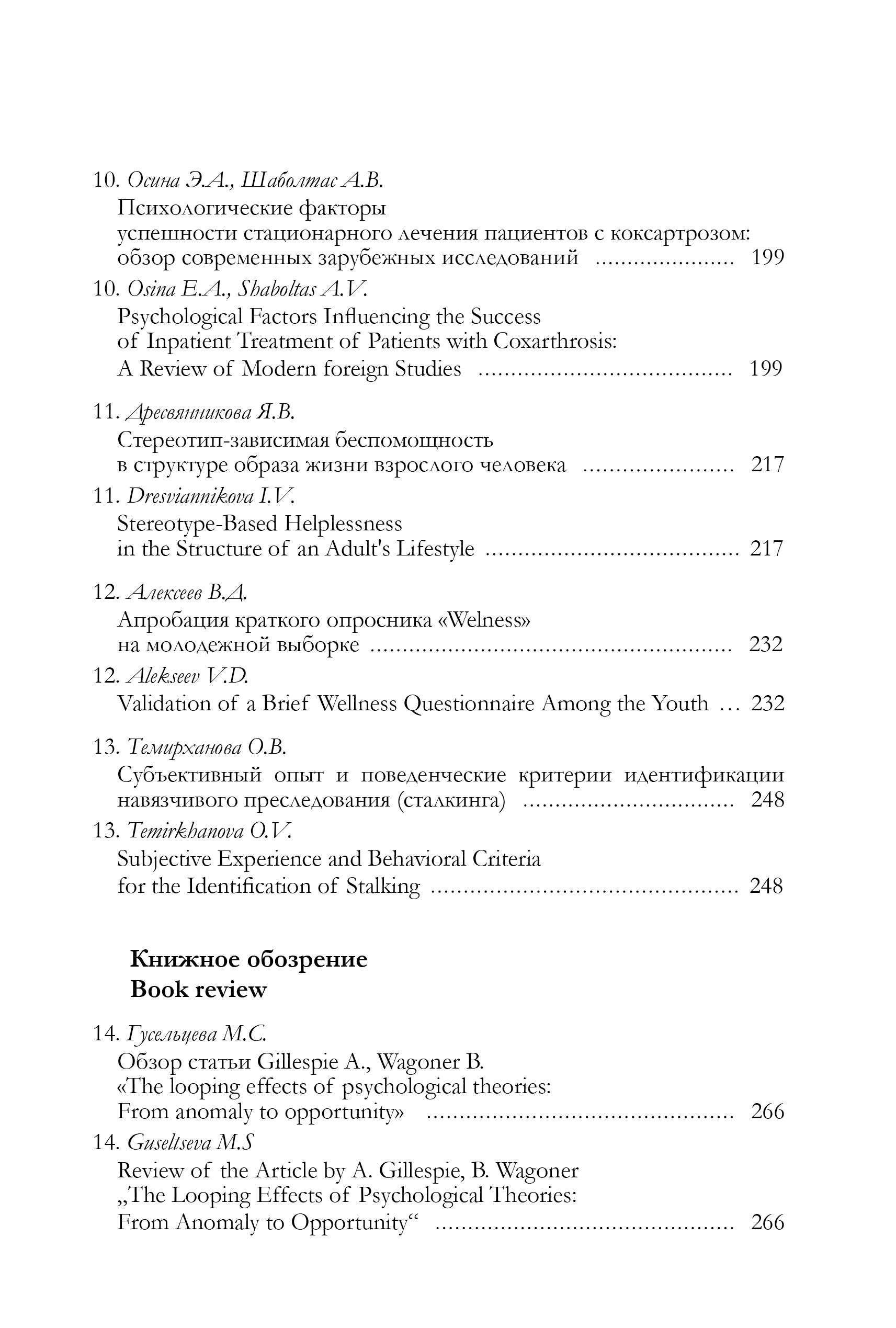
The article “Psychological factors influencing the success of inpatient treatment of patients with coxarthrosis: a review of modern foreign studies” by E.A. Osina and A.V. Shaboltas presents a review of current international studies examining the nature and impact of psychological factors on treatment outcomes for patients with coxarthrosis in short-term inpatient settings. The article highlights the importance of assessing psychological status within standard clinical protocols. This facilitates personalized treatment, as does the implementation of brief psychoeducational and cognitive-behavioral interventions.
In the article “Stereotype-Dependent Helplessness in the Structure of an Adult's Lifestyle”, Ya.V. Dresvyannikova investigated the impact of stereotype-dependent helplessness on the lifestyle components of adults. The findings revealed a destructive effect of stereotype-dependent helplessness on all aspects of adults' lifestyles, including the emotional and behavioral spheres.
O.V. Temirkhanova’s article, “Subjective Experience and Behavioral Criteria for Identifying Obsessive Pursuit (Stalking)”, demonstrates the high prevalence of stalking behaviors. The findings highlight the complexity involved in perceiving and interpreting the experience of stalking and underscore the need for a comprehensive approach to diagnosis and support for victims.
In the study “Validation of the Brief 'Wellness' Questionnaire on a Youth Sample”, V.D. Alekseev conducted a psychometric evaluation of the brief version of his “Wellness” questionnaire. It serves as a valid and reliable tool for assessing key aspects of well-being among Russian youth. The questionnaire is recommended for use in population-based studies, screening programs, and preventive work, and can also serve as a foundation for future longitudinal and clinical research.
M.S. Guseltseva presents an overview of the article “The Looping Effects of Psychological Theories: From Anomaly to Opportunity” by A. Gillespie and B. Wagoner. The concept of cyclical effects, or the “looping effect”, was developed by the Canadian philosopher of science Ian Hacking (1936–2023). Methodologically, the “looping effect” implies that in the humanities and social sciences, the object of study changes under the influence of the research process itself. However, the authors of the reviewed article – A. Gillespie and B. Wagoner – argue that looping effects can be beneficial if taken into account during the development of psychological theories. Specifically, understanding looping effects in the context of people, their states, and their behavior challenges the notion of these as stable, immutable entities, encouraging us instead to view the research subject as a changing individual in a changing world. The authors conclude that by conceptualizing and harnessing feedback loops, psychological science can generate productive theories that not only improve human behavior but also become stronger and more robust over time.
I wish all authors and readers a successful new academic year!

Received: 26th septemper 2026
Published: 26th septemper 2026